Proyecto LUMEM
Estamos muy orgullosos de anunciaros que desde Viromii estamos participando en el proyecto LUMEM, financiado por IVACE+i, la Generalitat Valenciana y la Unión Europea a través del Programa FEDER Comunitat Valenciana 2021–2027.
LUMEM: Detección, predicción y tratamiento cuaternario de aguas residuales mediante nuevas tecnologías combinadas de membranas, adsorción y fotocatálisis para mejorar la calidad del agua regenerada y avanzar hacia una gestión más eficiente y circular del recurso hídrico.
- Objetivos: El objetivo principal del proyecto es evaluar la eficacia de un sistema cuaternario innovador, compacto y portátil, que integra filtración por membranas, adsorción y fotocatálisis para eliminar contaminantes emergentes en aguas residuales urbanas e industriales, incluyendo PFAS, microplásticos y fármacos como diclofenaco y claritromicina. Además, el proyecto desarrollará un sistema de monitorización y predicción basado en Inteligencia Artificial (IA) para detectar estos contaminantes y optimizar su eliminación en tiempo real.
- Descripción: LUMEM nace como respuesta a los nuevos requisitos regulatorios derivados de la nueva Directiva europea sobre el tratamiento de aguas residuales urbanas, que incorpora la necesidad de aplicar tratamiento cuaternario para la eliminación de microcontaminantes. Frente a soluciones aplicadas de forma aislada, LUMEM propone una integración sinérgica de tecnologías avanzadas, membranas, adsorción y fotocatálisis, en un único sistema, con el objetivo de generar conocimiento técnico-científico aplicable como tratamiento cuaternario en EDARs y contribuir a la economía circular, la innovación tecnológica y la sostenibilidad del sector.
- Socios participantes del proyecto: Viromii | Sociedad de Agricultores de la Vega (SAV) | Instituto de Ciencia Molecular (ICMOL, Universitat de València) | Amphora Process | AIMPLAS.
Actuación cofinanciada por la Unión Europea a través del Programa Fondo Europeo de Desarrollo Regional (FEDER) de la Comunitat Valenciana 2021-2027

Proyecto BIOVALSA
Estamos muy orgullosos de anunciaros que desde Viromii estamos participando en el proyecto BIOVALSA, financiado por el Instituto Valenciano de Competitividad e Innovación (IVACE+i).
BIOVALSA: Investigación de nuevos mecanismos de valorización de residuos lignocelulósicos típicos de la Comunidad Valenciana para la producción de bioplásticos funcionales.
- Objetivos: El objetivo principal del proyecto es transformar los residuos lignocelulósicos en productos de alto valor añadido para la industria del plástico, desarrollando rutas innovadoras y procesos más sostenibles y viables económicamente.
- Descripción: Los residuos lignocelulósicos son un recurso abundante en la Comunidad Valenciana. Este proyecto busca convertir estos residuos en biopolímeros clave, como el ácido poliláctico (PLA) y el polibutileno succinato (PBS), promoviendo un modelo de economía circular con gran impacto ambiental y económico en la región.
- Socios participantes del proyecto: AIMPLAS | VIROMII | Prime Biopolymers | Universidad Politécnica de Valencia | BIOBAM.
Proyecto BIOPLA
Encantados de anunciar que Viromii está participando en el proyecto BIOPLA, financiado por la Agencia Valenciana de la Innovación (AVI).
BIOPLA: Reciclado biológico de residuos de paja de arroz de la Comunitat Valenciana mediante su fermentación a ácido láctico y posterior polimerización a ácido poliláctico.
- Objetivos: El objetivo principal del proyecto es el de desarrollar un proceso que permita valorizar la paja de arroz en bioplásticos.
- Descripción: La paja de arroz es un residuo muy importante en la Comunitat Valenciana, especialmente en el Parque Natural de la Albufera, por lo que el proyecto tendrá un gran impacto en la economía circular y a nivel medioambiental en la región valenciana.
- Lideran el proyecto: Agricultores de la Vega de València (SAV)
- Socios participantes del proyecto: Prime Biopolymers | AIMPLAS | VIROMII
Proyecto BIOREACT
Encantados de anunciar que Viromii está participando en el proyecto Bioreact, financiado por la Agencia Valenciana de la Innovación (AVI).
BIOREACT: Reciclado biológico de residuos plásticos de almidón mediante su fermentación a ácido láctico.
- Objetivos: El objetivo principal del proyecto es utilizar la innovación para valorizar los residuos plásticos transformándolos en ácido láctico, empleable en la creación del ácido poliláctico (PLA), un bioplástico muy versátil con diversas aplicaciones en distintas industrias como la médica, textil así como de envases y envolturas gracias a sus magníficas propiedades y su gran biodegradabilidad. Características que le garantizan un gran futuro en la sustitución de los plásticos de la petroquímica.
- Descripción: El proyecto se centra en la valorización y reciclado de residuos plásticos con base polimérica de almidón tales como bolsas o acolchados habitualmente utilizados en agricultura. Estos residuos hasta la fecha terminaban su vida útil por biodegradación en los suelos ocupados ocasionando perjuicio sin remedio, ya que las clásicas alternativas de reciclado de plástico no resultaban lo suficientemente provechosas de llevar a cabo. Por medio de la investigación que se llevará a cabo en el proyecto BIOREACT se busca utilizar la innovación para dar valor a estos residuos plásticos cada vez más utilizados y producidos en la actualidad al aumentar sus tasas de reciclado y valorización, evitando así que esta corriente termine por resultar nociva y poco rentable para el medio y puedan obtenerse materiales reciclados de una calidad y valor económico superiores.
- Socios participantes del proyecto: Universidad de València | Plásticos Industriales y Comerciales de Alfarrasí (PICDA) | AIMPLAS | VIROMII
Divulgation: a fundamental support for innovation
Innovation can be defined in many ways; it is a broad concept. In general, people think about innovation as finding better ways of doing something, this would be incremental innovations. But there are also transformative and disruptive innovations, which usually create new markets and totally different ways of doing things.
Regardless of the many definitions, innovation is a trendy concept that is now on everyone’s lips, but what is needed to succeed through innovation?
- Creativity is the heart that drives the innovative process. It is necessary if you want to transgress previously established ideas and it is also essential to think outside the box. But being creative does not mean being an inventor, it implies seeing beyond what is taken for granted.
- Research and development are the brain of innovation, this part is in charge of building this process on a stable foundation. They set up logical criteria on which creativity can be developed.
- Diffusion is about making your innovative findings known. You will really know if your innovation has been successful when people know about it. At that moment, they will have the opportunity to test it and give you their opinion. It is a key process although in many cases it is forgotten.
If we focus on this last point, we will agree that the pandemic triggered by SARS-CoV-2 has revealed a communication revolution. Influenced by social media and the easy access to the internet, new communication strategies are being developed, and the pandemic has accelerated this natural process, especially in relation to science. Science and its divulgation are at a turning point, gaining more and more news coverage.
In times of crisis, like the one we are experiencing, it is necessary to transgress the conventional. Creativity, research and development are used to break down pre-set criteria and establish new standards. But, if we want that all these new findings and advances have a real impact, they need to reach society and be known.
However, explaining relevant information using specialized knowledge is not easy. This is what scientific divulgation is about, aiming to bridge the gap between the scientific world and society, opening a channel that allows people to integrate scientific knowledge into their culture. In other words, divulgation is the channel for transmitting innovation to the world.
We must not forget that, as we are all part of the same economic flow, it is important that everyone knows about our advances and innovations. Some years ago, few seemed to care about budget cuts in science or health until the pandemic broke out, and that was because no one felt these fields were relevant to them. However, due to this pandemic the general public has been finally able to understand the importance of science and if we don’t want to be the next expendable field, we cannot leave it to chance. It is important to communicate our progress clearly and rigorously, making sure everyone understands the latest advances in our sectors. If we do not let innovation reach society, it will lose half of its meaning, because less people would benefit from the latest and most revolutionary advances.

2020 at Viromii, what a year!
What a strange year! At Viromii we wanted to share our evolution now that we are facing the end of 2020. Since our first client in 2018, when we created the company, we have been doing what every other young company should do, which is to validate the business model with potential customers. Throughout this validation, we shaped the company into what it is today, a tech-focused consultancy firm that supports business development and technology transfer operations and works mainly with research-intensive institutions and high-tech firms.
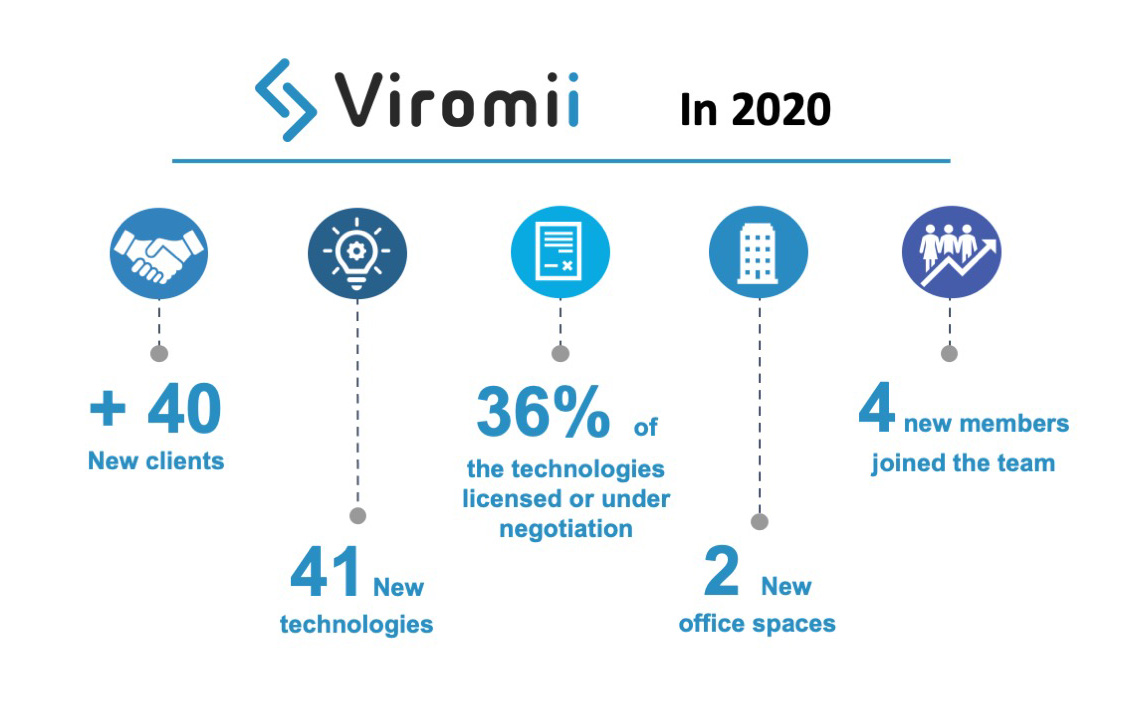
Now, we are still working from the Start-UPV ecosystem, but we moved from the coworking space to renting two private office spaces. Another core milestone for us is the team, which has also expanded. Now, we are happy to have Laura Nuñez, an industrial engineer and MBA who recently became a full-time Project Manager at Viromii. Also, we started working on our communication and market reach with the experienced support of Raquel Martínez, which has started working with us recently. Finally, we grew our technical team with Guillermo Lillo and Cristina Catalá, two promising engineers with impressive business capabilities.
This year, one of the most relevant achievements for us has been to surpass the 40 client barrier. Furthermore, many of the projects we have this year are from previous clients, which means that we are on the right track and led us to double our yearly revenue. During this year’s projects, we worked with 41 new technologies, including patented inventions, spin-off and start-ups, and trade secret-protected technologies. Also, we have signed or are currently negotiating a licensing agreement for 36% of the technologies we have in our tech-transfer portfolio.
Last but not least, we kept our team multicultural and multidisciplinary, always learning from each other and trying to create an open and innovative space for new ideas and ways of working. We hope you enjoyed the read, keep tuned for new posts!
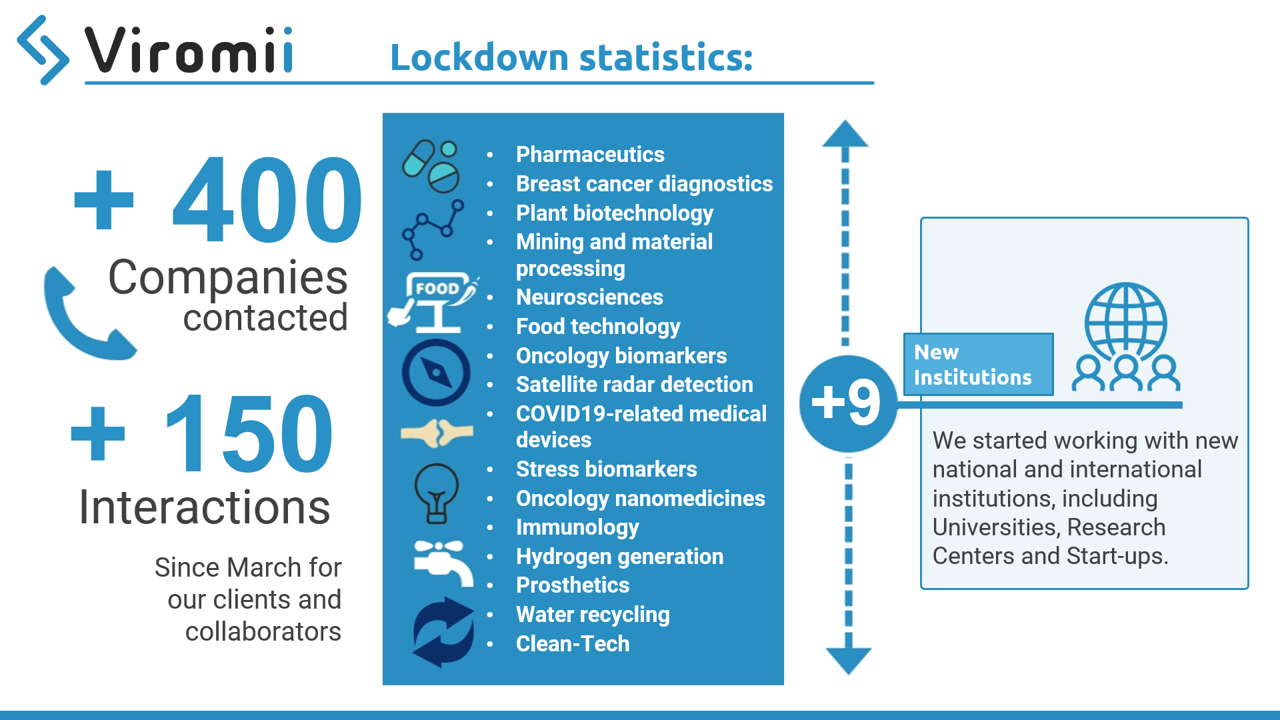
Activity update during the COVID-19 lockdown
Finally, after more than 3 months working remotely, we are back at the office! Of course, keeping all the safety measures and only 2 days/week, but it is great to have the team together again. Despite the long time of complete remote working, the activity has not stopped. Here we want to share with you an update on our activity during the lockdown.
Thanks for this amazing 2019!
An entire year has passed, and from Viromii we can say that it has been really exciting and we have had lots of fun. So we want to thank all our clients and partners, and all the people that have contributed to making Viromii something real from its very beginning.
We have been lucky to work with great research institutions nationally and at an international level, and several innovative companies. All this trust has helped Viromii to grow its team and to start a digitalization process, where we are creating some software tools that will boost Viromii’s efficiency and help to deliver even more value in our services.
Finally, and again, thanks to everyone that has trusted or been part of Viromii during 2019. We are looking forward to keeping growing together with you in this and the following years.
Theranostics – an innovative approach against cancer
During the past months, at Viromii we have been working with some innovative cancer therapies. Concretely, we have been working with a theranostic technology in the field of nanomedicines.
It is well known that, what we know as Cancer covers a set of more than 200 different diseases, each of them with very different physiology, medical approach, prognosis and results for the patients. Every year, there are around 20 million new cancer patients having a huge impact on the global economy, which was estimated in 2010 at approximately US$ 1.16 trillion.
Commonly, cancer treatments are based on radiotherapy, small-molecule chemotherapy, and tumor resection, but new therapies such as immunotherapies, personalized medicine, and early diagnosis tools based on DNA sequencing are now on the spotlight. One of the main reasons for this constant search for new therapies is the high toxicity and how physically harmful some of the current treatments are. Unfortunately, the most common cases are the side effects of the chemotherapy, including hair loss, loss of appetite and loss of body mass, dry skin, anaemia, nausea, etc. All these side effects come because small-molecule chemotherapy is no other than a cancer-specific toxic chemical agent, which usually is administered parenterally. Because of this, the chemotherapy agent can affect other healthy cells, hence causing the multiple side effects previously mentioned.
One of the approaches to solve this is the use of nanomedicines, which can deliver the chemotherapeutic agents onto the cancer cells, therefore reducing systemic toxicity. In this field, several technologies have been developed, being the micelles and liposomes the most popular nowadays. These nanoparticles, however, have been presenting several problems, mainly due to the lack of control and selectivity when releasing the chemotherapeutic agent. To solve this, a new variety of nanomedicines is being created, called Theranostics. Theranostic is the combination of the words “therapeutic” and “diagnostic”, which comprises the nanomedicines that can offer a therapeutic effect, and through an imaging technique it allows the possibility to follow the response to the therapy in-vivo. Several studies in this field are being carried out by big and small companies, as this new technology seems promising due to the fact that it allows the physician to follow the treatment in vivo, therefore making possible to know if the treatment is being specific and/or efficient, which would facilitate the dosing, reduce the toxicity, and increase the positive results.
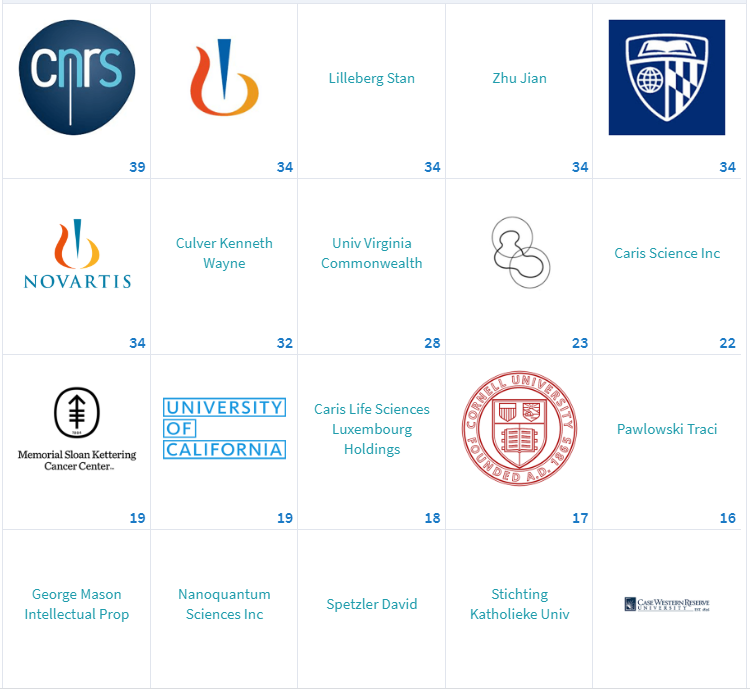
After a brief patent analysis, it is confirmed how innovative the theranostic field is. As it can be seen in the following figure, theranostics started to become a trend in patent filings in 2012, and now it is growing at a very fast pace, but still being under 1000 patents worldwide.
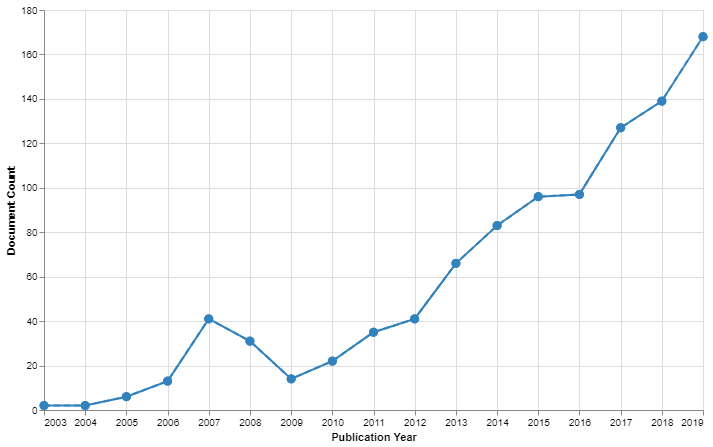
Another indicator of how experimental this technology is, is the fact that seven out of the top ten applicants for this technology are research organizations.
At Viromii we are really excited to work with cutting edge medical technologies and we are confident that companies will keep investing to bring these innovations to the patients. We hope you enjoyed the read, see you around!
Biohub VLC – a first step for consolidating Valencia as a biotech hub?
In one of the most privileged environments of the city of Valencia, also qualified as the pole of innovation and entrepreneurship, has born Biohub VLC, the first privately managed business centre in Spain to support Health Science Companies in scaling phase.
The Valencian Community stands out for its cluster in the Biotechnology sector, consolidating itself as the fourth Spanish region with more companies dedicated to this field and concentrating 10% of the sector in its territory. Over the last year, it has grown by 9.2% but, even so, there are still numerous factors that hinder the potential development of this industry, such as the scarce cooperation between the different agents in the sector, the difficulty in attracting talent or the lack of training in business management. With the objective of eliminating these frontiers and with the aim of fostering the Biotech sector in Valencia, Biohub VLC appears.
Biohub VLC counts with more than 3,600 useful square metres and an investment of 1.5 million in the refurbishment of the 5th Base of La Marina de Valencia, the aim is to create a participative space in which there is an exchange of knowledge, technology and economies of scale between companies and agents from the Health Sciences sector.
By signing agreements with major research centres, universities and hospitals at regional, national and international level, as well as with business associations, Biohub VLC seeks to put the city of Valencia in the spotlight of the biotechnology sector. This is the reason why, besides being an accelerator for biotech companies, it also intends to be a meeting place for the industry, with the celebration of congresses and events of both national and international nature.
At the beginning of 2020, Biohub VLC will become a reality with the welcome of the first company to move into its facilities: Imegen, the first of the 20 companies expected to set up in this centre.
From Viromii we are expecting to see how the project develops and how it impacts the development of the Biotech sector in the region.